


Hair thinning rarely happens overnight. It often begins with subtle changes, a wider parting, reduced volume, a receding hairline, or hair that gradually feels weaker than before. While these changes may seem minor initially, they can be signs of progressive hair loss.
Understanding the cause of hair thinning early can help you explore suitable treatment options. One approach that is gaining attention in hair restoration is G-Cell Hair Treatment, an autologous tissue-based procedure designed to support the scalp environment and existing hair follicles.
What Is G-Cell Hair Treatment?
G-Cell is an advanced autologous treatment that uses tissue obtained from the patient’s own body to prepare a cellular suspension for application to the targeted area.
In hair restoration, the procedure involves collecting a small tissue sample, processing it using a specialised system, and applying the prepared suspension to selected areas of the scalp.
Since the treatment uses the patient’s own tissue, it is described as an autologous approach. The procedure is intended to support existing follicles and the scalp environment, particularly in areas experiencing hair thinning.

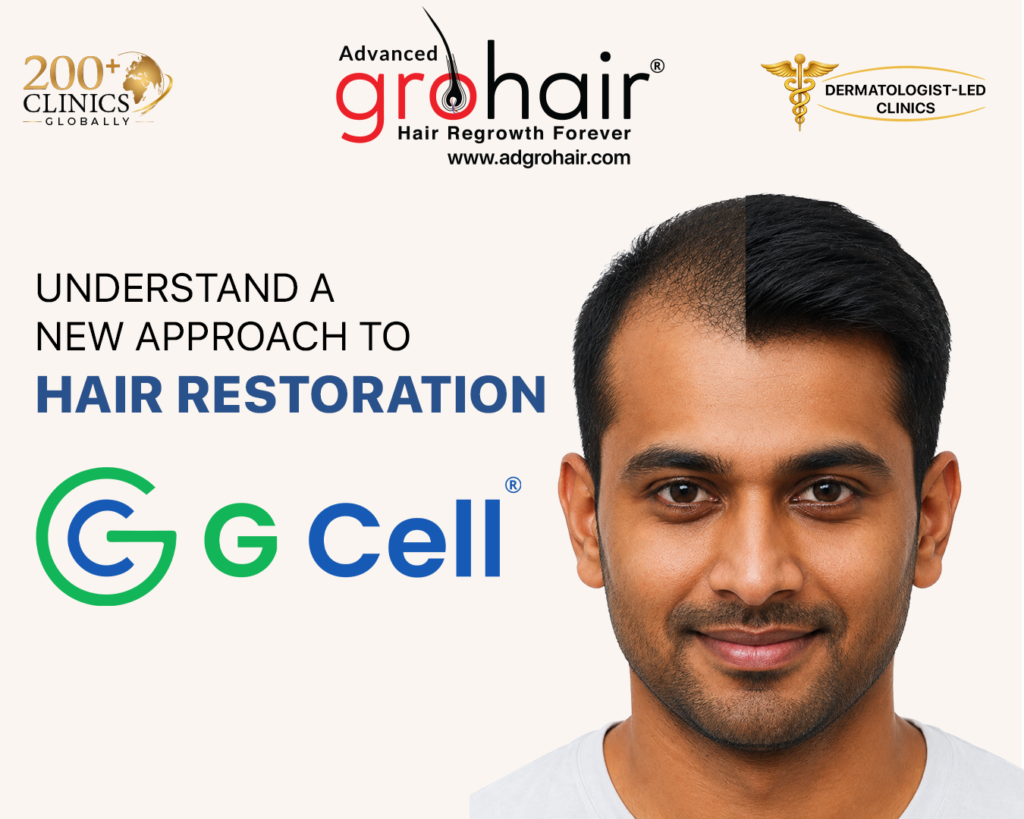
Images used in this blog are for illustrative purposes only.
How Does G-Cell Treatment Work?
Hair follicles are influenced by several factors, including genetics, hormonal changes, age, and scalp health. As hair loss progresses, some follicles may gradually produce thinner and weaker strands.
G-Cell treatment follows a tissue-based approach that focuses on supporting the existing follicular environment.
The process generally involves:
- Tissue collection: A small tissue sample is collected from the patient's designated donor area following medical assessment.
- Specialised processing: The collected tissue is processed using a dedicated G-Cell system to prepare the autologous tissue suspension.
- Targeted application: The prepared suspension is applied to selected areas of the scalp based on the treatment plan.
The suitability, technique, and expected outcomes depend on individual assessment by the treating dermatologist.
What Hair Concerns Can G-Cell Treatment Address?
G-Cell may be considered as part of a personalised treatment plan for individuals experiencing certain patterns of hair thinning, including:
The process generally involves:
- Progressive hair thinning: Gradual reduction in hair volume and density.
- Weak or miniaturised hair: Hair strands that appear finer or weaker over time.
- Reduced hair density: Areas where the scalp has become more visible due to thinning.
- Early-stage hair loss: Initial signs of hair loss that require clinical evaluation.
- Receding hairline: Hairline changes that may be associated with progressive follicular miniaturisation.
The treatment is intended to support existing follicles. It should not be considered a guaranteed solution for every type or stage of hair loss, particularly in areas where follicles are no longer present.
Why Consider G-Cell for Hair Thinning?
One of the key aspects of G-Cell is its use of the patient’s own tissue. Rather than relying on externally sourced cellular material, the procedure follows an autologous approach.
Other aspects of the treatment include:
- A tissue-based approach to supporting the scalp environment.
- A procedure focused on areas with existing hair follicles.
- A non-surgical treatment approach.
- Personalised application based on the individual's hair and scalp assessment.
- The possibility of being considered alongside other dermatologist-recommended hair treatments, where appropriate.
The treatment plan and potential benefits should always be discussed with a qualified dermatologist.
Who May Be Suitable for G-Cell Hair Treatment?
G-Cell may be considered for individuals experiencing early or progressive hair thinning, reduced hair density, or weakened hair strands.
However, not everyone experiencing hair loss will be suitable for the procedure. The underlying cause of hair loss, scalp condition, follicular health, medical history, and individual expectations all need to be evaluated before recommending treatment.
A dermatologist can assess these factors and determine whether G-Cell or another treatment approach is more appropriate.
Why Is Early Hair Loss Assessment Important?
Hair loss can progress gradually, making it easy to overlook the early signs. By the time thinning becomes more noticeable, the underlying condition may have progressed.
An early consultation helps identify the possible cause of hair loss and provides an opportunity to understand the available treatment options.
Rather than choosing a treatment based only on visible symptoms, a professional scalp and hair assessment helps create a plan based on individual requirements.
Your Hair. Your Progress.
Hair restoration is not about following the same treatment plan as everyone else. It begins with understanding your hair, identifying the cause of thinning, and choosing an approach suited to your needs.
At Advanced GroHair & GloSkin, our dermatologist-led approach focuses on evaluating your hair and scalp before recommending a treatment plan.
Don’t just watch your hair get thinner. Take the first step towards understanding your hair concerns.
Book a consultation with Advanced GroHair & GloSkin and discover whether G-Cell Hair Treatment is suitable for you.
Frequently Asked Questions
What is G-Cell Hair Treatment?
G-Cell is an autologous tissue-based treatment that uses a prepared suspension from the patient’s own tissue. In hair restoration, it is applied to selected scalp areas as part of a treatment plan designed to support the existing follicular environment.
Is G-Cell a surgical hair transplant?
G-Cell is an autologous tissue-based treatment that uses a prepared suspension from the patient’s own tissue. In hair restoration, it is applied to selected scalp areas as part of a treatment plan designed to support the existing follicular environment.
Who can consider G-Cell Hair Treatment?
Individuals experiencing certain types of hair thinning, reduced density, or weakened hair may be assessed for the treatment. A dermatologist must determine suitability after examining the scalp and identifying the cause of hair loss.
Can G-Cell treat completely bald areas?
G-Cell is intended to support the environment around existing follicles. It should not be assumed to regenerate follicles in completely bald areas where follicles are no longer present.
Is one session enough for G-Cell Hair Treatment?
The treatment protocol may involve a single procedure, but the appropriate plan depends on the individual’s condition and the treating dermatologist’s recommendation. Results and maintenance requirements can vary.
How do I know if G-Cell is right for me?
A consultation and scalp assessment are necessary to understand the cause and extent of hair loss. Your dermatologist can then discuss whether G-Cell is suitable or whether another treatment would be more appropriate.
Medical Review Note: This article is intended for general educational purposes and does not replace professional medical advice. Treatment suitability, procedure details, potential benefits, risks, and expected outcomes should be discussed with a qualified dermatologist. All clinical claims and procedural details should be verified by the clinic’s medical team before publication.